Northwick

Services Stay ahead of Cyber Threats

Penetration Testing Services

OVERVIEW

Our Penetration Testing Services provide expert-led security assessments that simulate real-world cyberattacks to uncover vulnerabilities across your digital infrastructure.
 
With over two decades of cybersecurity experience, we go beyond automated scans by replicating advanced attacker tactics to identify systemic risks and strengthen your defences.
 
Each engagement delivers clear, actionable remediation guidance, zero disruption to operations, and retesting to confirm all issues are resolved, helping you achieve compliance, enhance resilience, and stay ahead of evolving threats.

TYPES OF PENETRATION TEST

Our Penetration tests follow a structured process designed to uncover vulnerabilities before attackers do. Each phase plays a critical role in ensuring a thorough and ethical assessment of your systems.
Active Directory Advisory Simulation Baseline External Network Internal Network IoT (Internet of Things) Mobile App Network Security Phishing Red Team Secure Code Web Application Wireless

We assess the security of your organisation’s Active Directory environment. It targets misconfigurations, privilege escalation paths, and authentication weaknesses. The scope includes enumeration of users, groups, trusts, and policies, exploitation of access controls, and testing lateral movement to identify risks that could compromise domain integrity.


We mimic threat actor tactics to evaluate you organisation’s security posture under realistic conditions. The scope includes strategic attack planning, stealthy execution, and collaborative analysis. It focuses on identifying systemic weaknesses, testing incident response, and providing actionable insights aligned with threat intelligence and business risk.

We provide a foundational assessment of your organisation’s security posture. It identifies common vulnerabilities across networks, systems, and applications using standard attack techniques. The scope includes scanning, exploitation, and reporting, offering a benchmark for future security improvements and helping prioritise remediation efforts based on risk exposure.

We assess the security of your publicly accessible systems and services. The scope includes identifying vulnerabilities in firewalls, web servers, VPNs, and other perimeter devices. It simulates attacks from outside the organisation to uncover exposure points, misconfigurations, and weaknesses that could be exploited by external threats.

We simulate an attacker who has been able to access your internal environment. The scope includes identifying vulnerabilities in workstations, servers, network devices, and access controls. It tests lateral movement, privilege escalation, and data access to uncover risks that could be exploited by malicious insiders or compromised accounts.

We evaluate the security of Internet of Things devices and their ecosystems. The scope includes assessing firmware, communication protocols, APIs, and mobile interfaces. It identifies vulnerabilities like weak authentication, insecure data transmission, and device misconfigurations, ensuring robust protection against exploitation and unauthorised access across connected environments.

Our Mobile App Penetration Test evaluates the security of your mobile applications across iOS and Android platforms. The scope includes testing for data leakage, insecure storage, weak authentication, and API vulnerabilities. It involves static and dynamic analysis to uncover flaws in code, communication channels, and user input handling.

We evaluate the resilience of your organisation’s infrastructure against external and internal threats. The scope includes identifying vulnerabilities in firewalls, routers, switches, and endpoints. It involves scanning, exploitation, and analysis of network protocols, configurations, and access controls to uncover weaknesses and recommend security enhancements.

We evaluate your organisation’s susceptibility to social engineering attacks. It involves crafting realistic phishing emails or messages to test employee awareness, response behaviour, and incident reporting. The scope includes scenario design, delivery, monitoring, and analysis to identify training gaps and improve security awareness across the workforce.

We simulate real-world cyberattacks to assess your organisation’s security posture. We target systems, networks, and personnel using stealthy tactics to identify vulnerabilities, test detection and response capabilities, and improve overall resilience against advanced threats. The scope includes reconnaissance, exploitation, and post-exploitation activities.

We focus on identifying vulnerabilities within your Application Source Code. It involves manual and automated analysis to detect flaws like injection risks, insecure authentication, and poor error handling. The scope includes reviewing code structure, logic, and security controls to ensure robust, secure development practices are followed.

Our Web Application Penetration Test identifies security flaws in your web-based systems. The scope includes testing for vulnerabilities like SQL injection, cross-site scripting (XSS), authentication bypass, and insecure APIs. It involves manual and automated techniques to assess input validation, session management, and access controls, ensuring robust protection against online threats.

We will assess the security of your organisation’s wireless infrastructure. The scope includes identifying vulnerabilities in Wi-Fi configurations, encryption protocols, access controls, and rogue devices. It simulates attacks like unauthorised access, man-in-the-middle, and signal interception to uncover risks and strengthen wireless network defences.

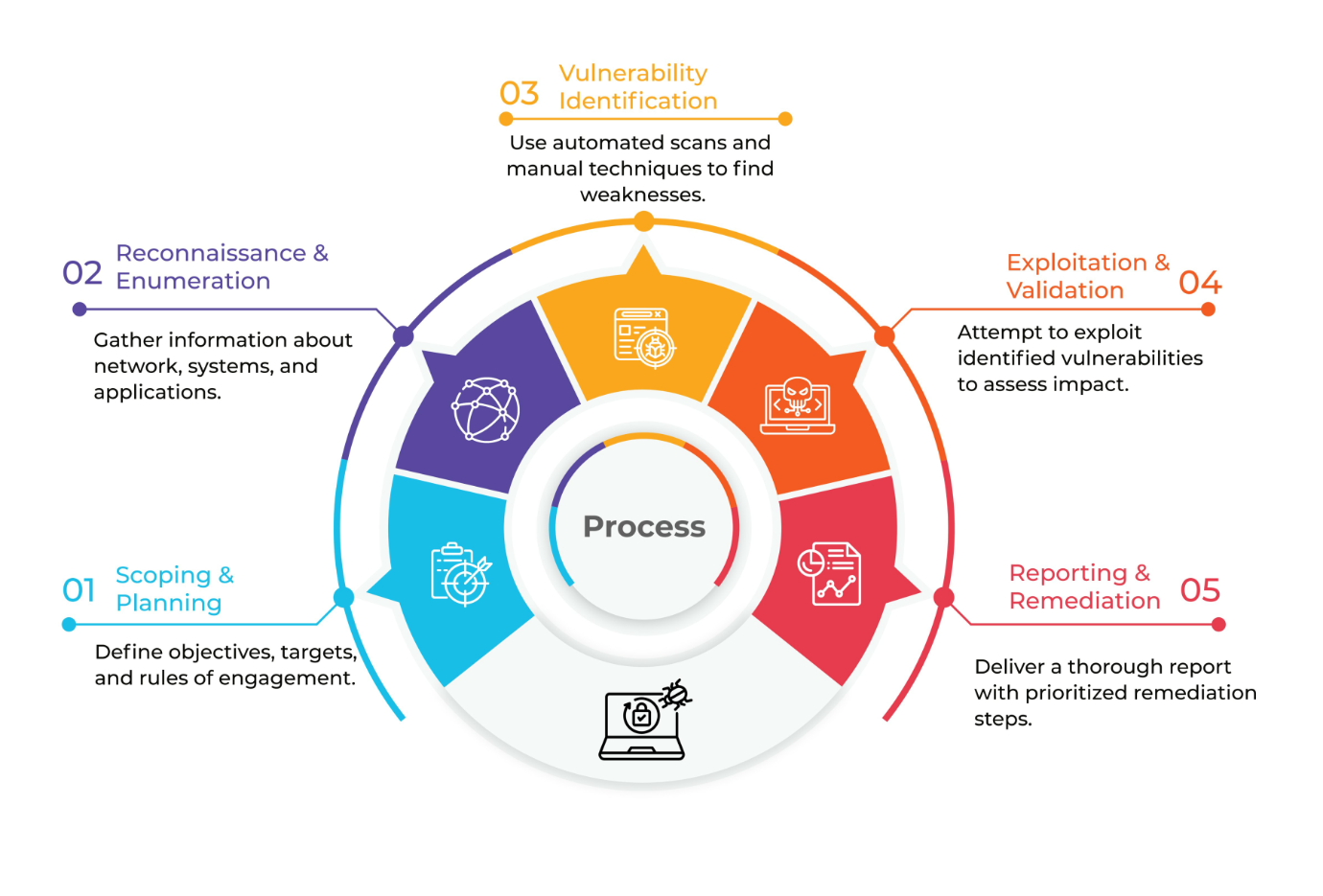
PHASES OF PENTRATION TESTING

OUR PENETRATION TESTING METHODOLOGIES

1. Scope Identification

At the outset we clearly identify the assets to be assessed, including systems, networks, applications, and endpoints. We will confirm the scope with your identified stakeholders and secure the necessary access credentials. If required, we can exclude sensitive or production systems to avoid operational disruptions and ensure testing remains within agreed boundaries.

2. Threat Modelling

We start by identifying your key business assets and processes that require protection. Then, map the relevant threat communities and assess attacker capabilities. Finally, we model potential attacker motivations and impact scenarios to understand how the threats could affect your operations and guide you to implement effective security strategies.

3. Testing Approaches

Penetration testing can be conducted using three main approaches.
  • Black Box Testing - We simulate an external attacker with no prior knowledge of your environment.
  • White Box Testing - We are provided with full access to systems and code, mimicking an insider threat to your systems.
  • Grey Box Testing - We are provided with partial access, representing a semi-informed attacker with limited internal knowledge.

4. Techniques Used

Penetration testing techniques span several categories.
  • Active Techniques - Involves direct engagement, such as exploitation attempts, payload injection, and privilege escalation.
  • Passive Techniques - Includes network sniffing, open-source intelligence (OSINT), and reconnaissance without system interaction
  • Social Engineering - Targets human vulnerabilities through phishing, impersonation, or phone-based manipulation.

5. Toolsets and Frameworks

We use a mix of tools and standards to ensure thorough assessments are undertaken. Both manual and automated tools, such as Metasploit and Burp Suite, are employed to identify and exploit vulnerabilities. Industry frameworks like OWASP, PTES, OSSTMM, and NIST 800-115 guide our methodology. Additionally, our testers have developed proprietary custom scripts and payloads to simulate advanced threats and tailor exploits to your specific environments.

6. Vulnerability Detection and Exploitation

Our testing involves identifying your security weaknesses such as misconfigurations, outdated software, and weak authentication mechanisms. Our testers then exploit these vulnerabilities to evaluate their real-world impact. Findings are classified by severity, Critical, High, Medium, or Low risk, to help prioritise remediation efforts and strengthen your organisation’s overall security posture.

7. Reporting and Remediation

Our testing concludes with the delivery of a detailed risk assessment report outlining identified vulnerabilities and their potential impact. These findings are prioritised with clear, actionable remediation steps. To support your internal teams, workshops can be conducted to explain the issues identified, guide the team to fixes, and strengthen your team’s overall security awareness and response capabilities.

8. Validation and Retesting

We complete the Penetration Testing process, by follow-up testing, which is conducted to verify the effectiveness of the remediation efforts. This ensures that previously identified vulnerabilities have been properly addressed by your team. Once confirmed, documentation is updated to reflect the closure of issues and to maintain an accurate record of the your organisation’s improved security posture.

9. Compliance Alignment

All of your Penetration testing findings should be mapped to relevant compliance standards such as ISO 27001, SOC 2, GDPR, and PCI-DSS. This ensures the testing process supports your audit team's readiness and helps your organisations meet regulatory obligations by aligning security improvements with industry and legal requirements.

10. Continuous Improvement

We strongly recommend that your penetration testing should be integrated into your organisation’s broader security strategy to ensure continuous protection. We recommend regular (at least annually or when major updates are implemented in your network) assessments and updates to threat modelling to stay ahead of evolving risks, maintain resilience, and align security efforts with your business objectives.

HOW MUCH ACCESS IS GIVEN TO THE PENETRATION TEAM

Required access will depend on the test type and objectives of the Penetration Test. In Black-box testing, minimal access is provided, simulating an external attacker. Grey-box testing offers limited internal knowledge, while White-box testing grants full access to systems, credentials, and architecture. Access is carefully controlled to balance realism with safety, ensuring accurate results without disrupting operations. Clear rules of engagement, scope boundaries, and escalation procedures are defined beforehand to guide the testers and protect critical assets. Ultimately, access is tailored to meet the organisation’s risk appetite and compliance requirements.

PENETRATION TESTING TECHNIQUES

Penetration testing techniques are categorised into Active and Indirect methods.

Active techniques involve direct interaction with systems, such as exploiting vulnerabilities, scanning ports, and attempting privilege escalation.

Indirect techniques focus on passive information gathering, like monitoring network traffic, analysing metadata, and conducting reconnaissance without triggering alerts. Together, they provide a comprehensive view of security weaknesses and potential attack paths.

HOW TO ENGAGE WITH US

Reach out to us either by:

  1. Hit the ‘Book a Meeting with us’ Button and find a convenient time to drop a meeting in the calendar
  2. Drop us an email to ‘contactus@northwickcyber.com’, we will get straight back to
  3. Hit the ‘Contact Us’ button and let us know what you are interested in and we will contact you back
  4. Call us on ‘+61 1800 959 925

Once we have communicated and understood your requirements we will organise a convenient Introduction and Consultation with the Cyber Team. Our process after that is :

1. Introduction and Initial Consultation

We begin the technical discussion with a discovery session to understand your business, security goals, and compliance requirements. During the session we will provide you with guidance and advice if you have never undertaken a Penetration Test. This will help us to tailor the testing approach to your environment.

2. Scope Definition

Together, we define the assets to be tested, networks, applications, endpoints, or cloud infrastructure, and agree on exclusions, access levels, and testing boundaries.

3. Proposal and Agreement

Once we have had the initial meeting and we have agreed on the scope, you will receive a detailed proposal outlining the testing methodology, timelines, deliverables, and costs. If you are happy with the proposal, we ask that you approve, to formalise the engagement.

4. Pre-Test Planning

We work with your team to gather access credentials, schedule testing windows, and establish communication protocols to ensure minimal disruption.

5. Execution of Testing

Our experts conduct the penetration test using a mix of manual and automated techniques, simulating real-world attack scenarios across the agreed scope.

6. Reporting and Remediation Guidance

You’ll receive a comprehensive report detailing findings, risk ratings, and actionable remediation steps. We also offer workshops to support your internal teams.

7. Post-Test Validation

Follow-up testing is available to verify that vulnerabilities have been successfully remediated and to confirm closure.

8. Strategic Integration

We help integrate findings into your broader security strategy and recommend ongoing assessments to maintain resilience against evolving threats.

9. Project Closure

As all of our engagements include Project Management we will wrap up the engagement with a Lessons Learned and then a Project Closure session. At this stage we can identify next steps for maintaining the security posture.

WHY CHOOSE US

Northwick Cyber delivers expert-led penetration testing tailored to your business needs. Our team combines industry-standard methodologies with advanced tools and custom techniques to uncover real-world vulnerabilities across networks, applications, and infrastructure. We provide clear, actionable remediation guidance and support, ensuring your organisation meets compliance requirements and strengthens its security posture. With a focus on transparency, collaboration, and continuous improvement, Northwick Cyber helps you stay resilient against evolving cyber threats.

  • We Provide Tailored Testing – All assessments are customised to your environment, business processes, and risk profile.
  • Real-World Threat Simulation – All of our tests mimic actual attacker techniques to uncover your exploitable vulnerabilities.
  • Compliance Alignment – We support all industry standards such as – ISO 27001, SOC 2, PCI-DSS, and GDPR.
  • Clear Reporting – We provide detailed findings with risk ratings and actionable remediation steps for resolving vulnerabilities in your environment.
  • Expert Guidance – We provide workshops and support to help your internal teams understand and resolve issues.
  • Continuous Improvement – We provide recommendations for ongoing assessments and threat modelling updates.
  • Audit Readiness – We help you prepare for regulatory audits and security certifications ensuring you have everything you need.
  • Secure Operations – Testing is conducted safely, minimising disruption to production systems.
  • End-to-End Coverage – Includes network, applications, cloud, and mobile.
  • Post-Test Validation – We provide follow-up testing to ensure identified vulnerabilities are properly remediated and whether new ones have been opened.

Our Certifications

Scroll
Drag

About Us

Northwick Cybersecurity is a dedicated brand from Bushey Pty Ltd. that is focused on supporting your Cybersecurity needs and partnering to keep your business data and systems safe from data theft and breaches.

Contact Info

Level 1/9-11 Grosvenor St. Neutral Bay 2089 NSW Australia

FAQs – Penetration Testing Service

Q1. What is penetration testing?
Penetration testing simulates real-world cyberattacks to identify vulnerabilities in your systems, applications, and networks before malicious actors can exploit them.
Q2. Why should we choose Northwick Cyber?
Northwick Cyber offers tailored, expert-led testing aligned with industry standards, delivering clear remediation guidance and ongoing support to strengthen your security posture. With a 20+ year experience
Q3. What types of penetration tests do you offer?
We provide internal, external, web application, mobile app, wireless, IoT, Active Directory, social engineering, and physical security testing.
Q4. How is the scope of a test defined?
We work with stakeholders to define assets, validate scope, obtain access credentials, and exclude sensitive systems if required.
Q5. Will testing disrupt our operations?
No. All testing is conducted safely and carefully to avoid disruption to production environments.
Q6. What standards do you follow?
Our testing aligns with OWASP, PTES, OSSTMM, NIST 800-115, and supports compliance with ISO 27001, SOC 2, PCI-DSS, and GDPR.
Q7. What tools do you use?
We use a mix of manual and automated tools like Metasploit, Burp Suite, and custom scripts to simulate advanced threats.
Q8. How are vulnerabilities classified?
Findings are categorized by severity—Critical, High, Medium, or Low—based on potential impact and exploitability.
Q9. Do you provide remediation support?
Yes. We deliver detailed reports with actionable steps and offer workshops to guide internal teams through remediation.
Q10. Is follow-up testing included?
We offer follow-up testing to verify that vulnerabilities have been properly addressed and closed.
Q11. How does penetration testing help with compliance?
Testing helps meet regulatory requirements and prepares your organization for audits by mapping findings to relevant standards.
Q12. How often should we conduct penetration tests?
We recommend annual testing or after major system changes, with ongoing assessments and threat modelling updates for continuous security.
Q13. Can penetration testing be part of our broader security strategy?
Absolutely. We help integrate testing into your overall security framework to support long-term resilience and risk management.
Cart (0 items)
Select the fields to be shown. Others will be hidden. Drag and drop to rearrange the order.
  • Image
  • SKU
  • Rating
  • Price
  • Stock
  • Availability
  • Add to cart
  • Description
  • Content
  • Weight
  • Dimensions
  • Additional information
Click outside to hide the comparison bar
Compare