
Expert-led penetration testing that goes beyond automated scans to identify and validate real-world security weaknesses.







Penetration Testing Services
OVERVIEW
Understand your exposure. Prioritise what matters. Validate the fix.
Our penetration testing simulates real-world attack techniques across your applications, networks and infrastructure to identify vulnerabilities and determine how they could affect your organisation.
- Identify exploitable weaknessesDiscover vulnerabilities across the agreed testing scope.
- Understand the riskValidate how weaknesses could be exploited so your team can prioritise remediation.
- Remediate with clarityReceive clear, actionable guidance to address identified vulnerabilities.
- Validate the outcomeFollow-up testing can confirm that remediation has been effective and identified issues have been resolved.

What Our Clients Say
Thank you from us to you and your team for being so patient while we got our website reprovisioned. We are very happy with the results and we will be in touch for the next penetration test again.
TYPES OF PENETRATION TEST
We provide penetration testing across different environments and attack surfaces. Explore the testing options, or talk to us if you’re unsure which approach is right for your environment.
Active Directory
We assess the security of your organisation’s Active Directory environment. It targets misconfigurations, privilege escalation paths, and authentication weaknesses. The scope includes enumeration of users, groups, trusts, and policies, exploitation of access controls, and testing lateral movement to identify risks that could compromise domain integrity.
Advisory Simulation
We mimic threat actor tactics to evaluate your organisation’s security posture under realistic conditions. The scope includes strategic attack planning, stealthy execution, and collaborative analysis. It focuses on identifying systemic weaknesses, testing incident response, and providing actionable insights aligned with threat intelligence and business risk.
Baseline
We provide a foundational assessment of your organisation’s security posture. It identifies common vulnerabilities across networks, systems, and applications using standard attack techniques. The scope includes scanning, exploitation, and reporting, offering a benchmark for future security improvements and helping prioritise remediation efforts based on risk exposure.
External Network
We assess the security of your publicly accessible systems and services. The scope includes identifying vulnerabilities in firewalls, web servers, VPNs, and other perimeter devices. It simulates attacks from outside the organisation to uncover exposure points, misconfigurations, and weaknesses that could be exploited by external threats.
Internal Network
We simulate an attacker who has been able to access your internal environment. The scope includes identifying vulnerabilities in workstations, servers, network devices, and access controls. It tests lateral movement, privilege escalation, and data access to uncover risks that could be exploited by malicious insiders or compromised accounts.
IoT (Internet of Things)
We evaluate the security of Internet of Things devices and their ecosystems. The scope includes assessing firmware, communication protocols, APIs, and mobile interfaces. It identifies vulnerabilities like weak authentication, insecure data transmission, and device misconfigurations, ensuring robust protection against exploitation and unauthorised access across connected environments.
Mobile App
Our Mobile App Penetration Test evaluates the security of your mobile applications across iOS and Android platforms. The scope includes testing for data leakage, insecure storage, weak authentication, and API vulnerabilities. It involves static and dynamic analysis to uncover flaws in code, communication channels, and user input handling.
Network Security
We evaluate the resilience of your organisation’s infrastructure against external and internal threats. The scope includes identifying vulnerabilities in firewalls, routers, switches, and endpoints. It involves scanning, exploitation, and analysis of network protocols, configurations, and access controls to uncover weaknesses and recommend security enhancements.
Phishing
We evaluate your organisation’s susceptibility to social engineering attacks. It involves crafting realistic phishing emails or messages to test employee awareness, response behaviour, and incident reporting. The scope includes scenario design, delivery, monitoring, and analysis to identify training gaps and improve security awareness across the workforce.
Red Team
We simulate real-world cyberattacks to assess your organisation’s security posture. We target systems, networks, and personnel using stealthy tactics to identify vulnerabilities, test detection and response capabilities, and improve overall resilience against advanced threats. The scope includes reconnaissance, exploitation, and post-exploitation activities.
Secure Code
We focus on identifying vulnerabilities within your Application Source Code. It involves manual and automated analysis to detect flaws like injection risks, insecure authentication, and poor error handling. The scope includes reviewing code structure, logic, and security controls to ensure robust, secure development practices are followed.
Web Application
Our Web Application Penetration Test identifies security flaws in your web-based systems. The scope includes testing for vulnerabilities like SQL injection, cross-site scripting (XSS), authentication bypass, and insecure APIs. It involves manual and automated techniques to assess input validation, session management, and access controls, ensuring robust protection against online threats.
Wireless
We will assess the security of your organisation’s wireless infrastructure. The scope includes identifying vulnerabilities in Wi-Fi configurations, encryption protocols, access controls, and rogue devices. It simulates attacks like unauthorised access, man-in-the-middle, and signal interception to uncover risks and strengthen wireless network defences.
Not sure which type of testing you need?
Tell us about your environment, recent changes or security concerns and we’ll help you determine the appropriate scope.
PHASES OF PENETRATION TESTING
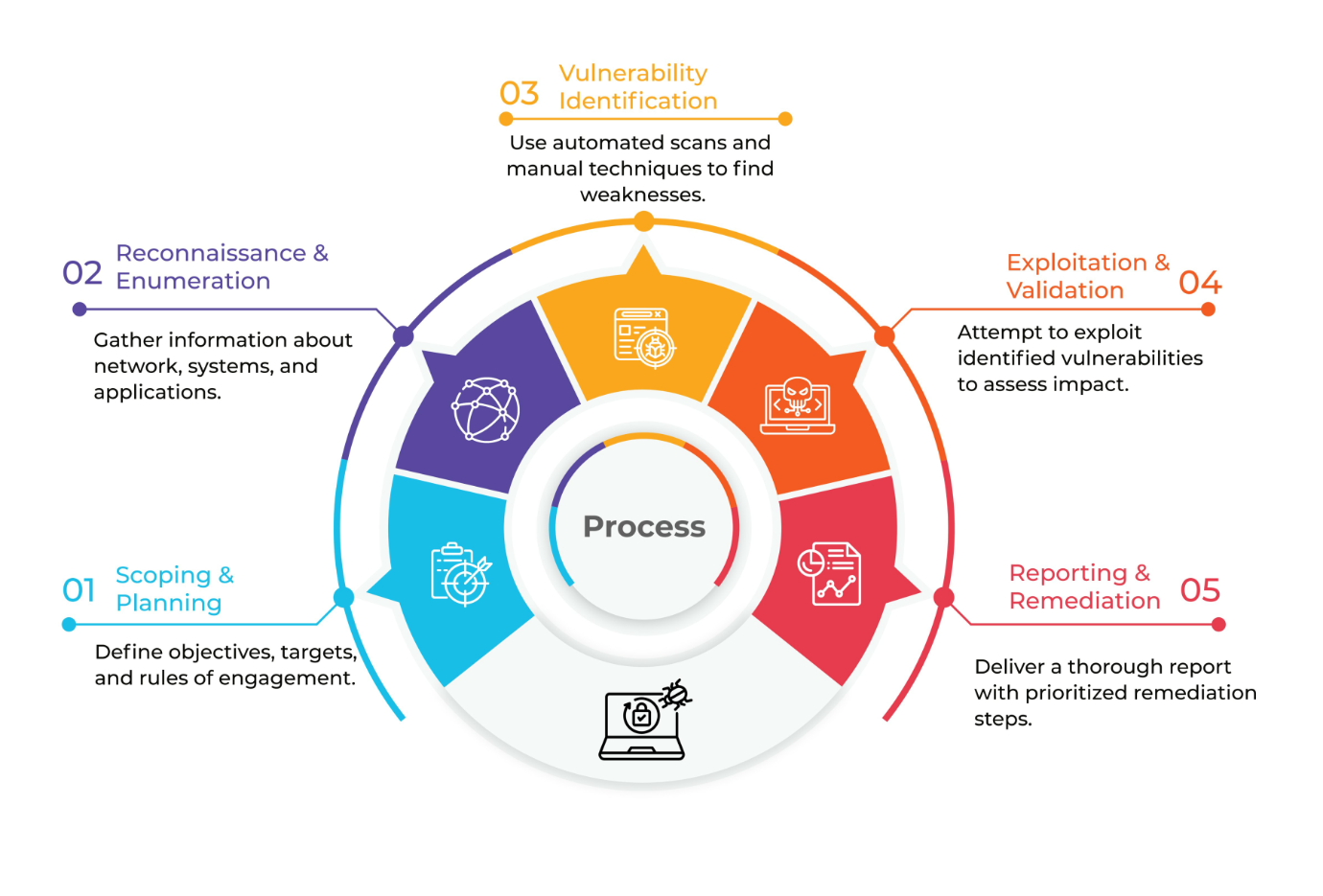
OUR PENETRATION TESTING METHODOLOGIES
1. Scope Identification
2. Threat Modelling
3. Testing Approaches
- Black Box Testing - We simulate an external attacker with no prior knowledge of your environment.
- White Box Testing - We are provided with full access to systems and code, mimicking an insider threat to your systems.
- Grey Box Testing - We are provided with partial access, representing a semi-informed attacker with limited internal knowledge.
4. Techniques Used
- Active Techniques - Involves direct engagement, such as exploitation attempts, payload injection, and privilege escalation.
- Passive Techniques - Includes network sniffing, open-source intelligence (OSINT), and reconnaissance without system interaction
- Social Engineering - Targets human vulnerabilities through phishing, impersonation, or phone-based manipulation.
5. Toolsets and Frameworks
6. Vulnerability Detection and Exploitation
7. Reporting and Remediation
8. Validation and Retesting
9. Compliance Alignment
10. Continuous Improvement
HOW MUCH ACCESS IS GIVEN TO THE PENETRATION TEAM
The level of access depends on the test objectives, environment and agreed scope.
Minimal access
Simulates an external attacker with little or no prior knowledge of the environment.
Limited access
Provides selected internal knowledge or credentials to test specific systems and attack paths.
Full access
Provides broader access to systems, credentials and architecture for more comprehensive testing.
PENETRATION TESTING TECHNIQUES
We combine active and indirect techniques to identify vulnerabilities and understand potential attack paths from different perspectives.
Active Techniques
Directly test systems for exploitable weaknesses
- Vulnerability exploitation
- Port and service testing
- Privilege escalation attempts
Purpose: Validate whether identified weaknesses can actually be exploited.
Indirect Techniques
Gather intelligence without directly exploiting systems
- Network traffic monitoring
- Metadata analysis
- Reconnaissance
- Passive information gathering
Purpose: Identify exposure and potential attack paths with limited direct interaction.
Used together, these techniques provide a broader understanding of exploitable weaknesses and potential attack paths.
HOW TO ENGAGE WITH US
Have a specific concern or not sure what type of testing you need? Tell us about your environment and we’ll help determine an appropriate testing approach.
Discuss Your RequirementsWhat happens next? ↓
- 1Phase 1
Plan
- Consultation
- Scope
- Proposal
- Pre-Test Planning
- 2Phase 2
Testing
- Penetration Testing
- 3Phase 3
Remediate & Validate
- Reporting & Remediation
- Post-Test Validation
- 4Phase 4
Close & Improve
- Strategic Integration
- Project Closure
WHY CHOOSE US
Our penetration testing is tailored to your environment, combining real-world testing with practical remediation guidance and post-test support. Explore what you can expect when working with Northwick Cyber.
Tailored Testing
Assessments are customised to your environment, business processes and risk profile.
Real-World Threat Simulation
Testing uses real-world attacker techniques to identify and validate exploitable vulnerabilities.
Clear Reporting & Expert Guidance
Receive prioritised findings, actionable remediation guidance and support to help your team address identified issues.
Secure & Compliant Testing
Testing is carefully controlled to minimise operational disruption while supporting relevant security and compliance requirements.
Post-Test Validation
Follow-up testing helps verify that identified vulnerabilities have been effectively remediated.